
Industrial System Audit for Heat Trace & Freeze Protection
Mission-Ready Freeze Protection.Every circuit tested, photographed, and recorded as structured data — so you know exactly what you have, what’s failing, and what to do about it, before a freeze event makes the decision for you.
A Complete Picture of Your System’s Health
Most facilities have heat trace systems that are older than their documentation. Cables degrade, insulation absorbs moisture, thermostats drift, and junction boxes corrode — often without anyone knowing, until something fails during a cold snap.
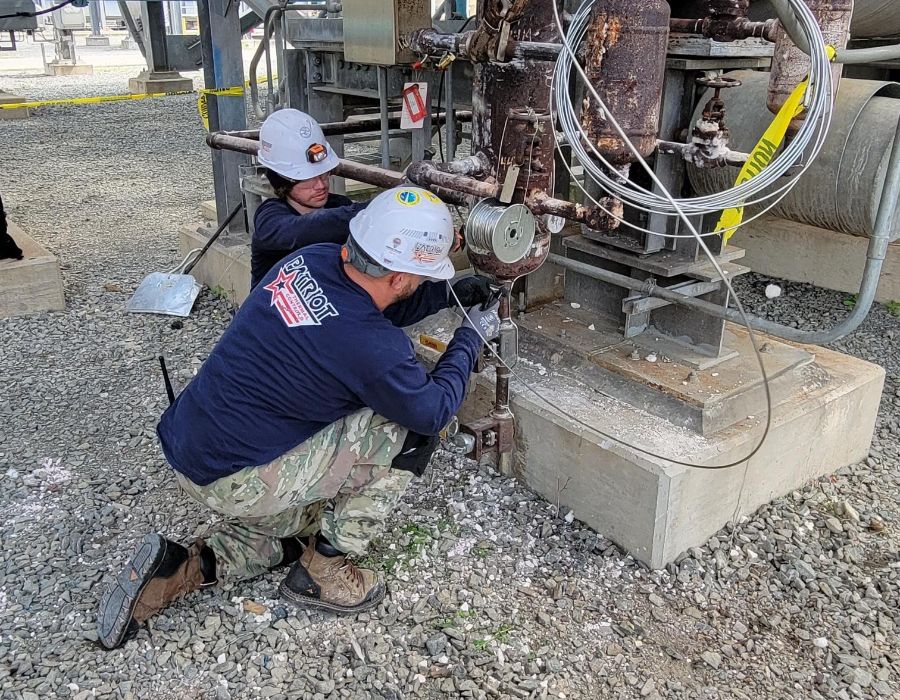
A Patriot heat trace and insulation audit is a systematic, circuit-by-circuit inspection of your entire system — captured on a digital field platform we built ourselves, not a clipboard. Every breaker is recorded as structured data: insulation resistance at the cable maker’s test voltage, circuit resistance, amp draw under power, photos of what we found — panel by panel, against real pass/fail thresholds. The result is a prioritized findings report delivered in days, and a permanent digital record of every circuit you own.
For many facilities, an audit is the first time anyone has taken a complete, objective look at the system since it was installed. What we find usually surprises people — and almost always prevents something expensive.
What the Audit Covers
- Visual inspection of all heat trace circuits and cabling
- Insulation resistance (megger) testing — every circuit
- Continuity and ground fault checks
- Insulation condition assessment — moisture, CUI, damage
- Thermostat calibration and setpoint verification
- Control panel review and alarm function testing
- Junction box inspection — seals, moisture ingress, connections
- Documentation audit — field vs. drawings comparison
- CIAC monitoring panel review (if installed)
- Optional: thermal imaging upgrade
Seven Situations That Demand an Audit
Any one of these is enough reason to bring Patriot in. Most facilities we audit have two or three of them in play at the same time.
Aging System — No Recent Inspection
If your heat trace was installed more than 10 years ago and hasn’t been professionally inspected, you have unknown risk. Systems degrade on a timeline that isn’t visible until something fails.
Incomplete or Missing Documentation
You inherited the facility, the installation contractor is gone, or the drawings don’t match the field. An audit rebuilds the documentation from what’s actually installed — not what was planned.
Recent Freeze Event or Near-Miss
A pipe froze, a circuit failed, or a thermostat stuck. That’s not bad luck — it’s a system that needs evaluation. An audit finds the other circuits at risk before the next cold event.
NERC Compliance Requirements
Power generation facilities have documented inspection requirements for heat trace systems under NERC standards. An audit produces the inspection records your compliance team needs.
Pre-Turnaround or Facility Assessment
Before a major shutdown or capital improvement project, an audit establishes baseline system condition — so you know what to include in the scope and what to budget for remediation.
New Maintenance Contract Starting
Before Patriot takes over maintenance responsibilities for a facility, we conduct an audit. It establishes the baseline both parties agree on and eliminates “we didn’t know” from the conversation.
Liquid Cooling Infrastructure — No Freeze Baseline
AI data centers, HPC campuses, and colocation facilities with outdoor dry coolers, cooling tower loops, and CDU piping are deploying water-based systems with no industrial-grade freeze protection assessment. An audit establishes what’s protected, what isn’t, and what the risk exposure is — before a freeze event answers the question for you. GPU rack downtime runs $100K–$500K per hour. A freeze baseline costs a fraction of that.
What Patriot Tests and Inspects
Our audit process follows a consistent, documented methodology across every facility — so findings are comparable, repeatable, and defensible in a compliance review. Our guide to what to inspect before cold season covers what each test measures and what you can check yourself.
Insulation Resistance Testing
Megger testing on every circuit identifies cable degradation before it causes a trip or a failure. We record baseline values and flag any circuits trending toward failure thresholds.
Visual Cable & Jacket Inspection
Physical inspection of accessible heat trace cable — looking for jacket damage, kinking, crushing, improper bends, and installation defects that affect performance or safety.
Junction Box Assessment
Junction boxes are the most common failure point in heat trace systems. We check every box for moisture ingress, corroded connections, damaged seals, and incorrect wiring.
Insulation Condition Survey
Damaged or wet pipe insulation compromises heat trace performance and creates CUI risk. We assess the condition of the thermal insulation jacket along audited lines and flag sections requiring replacement.
Thermostat Calibration Check
We verify thermostat setpoints against design specifications and test control accuracy. A thermostat that’s drifted even a few degrees off setpoint can allow a pipe to freeze in marginal conditions.
Control Panel & Alarm Review
Panel inspection covers breaker condition, wiring integrity, alarm function testing, and — where CIAC monitoring panels are installed — full review of monitoring status and alert configuration.
Documentation Comparison
We compare what’s in the field against existing drawings, panel schedules, and circuit IDs. Discrepancies are documented — and where documentation doesn’t exist, we create it from what we find.
Optional: Thermal Imaging
Infrared thermography can identify insulation gaps, hot spots, and uneven heat distribution that aren’t visible during a visual inspection. Available as an upgrade on any audit engagement.
Every Circuit Becomes a Permanent Record
Patriot’s instrumented audit replaces clipboard notes with structured field capture. Every circuit is tested, photographed, and graded in place — so the audit isn’t a snapshot that goes in a drawer, it’s a record that compounds year over year.
- Structured capture, real thresholdsMegs, ohms, and amps recorded on every circuit and graded against hard pass/fail lines — insulation resistance failing at 4.9 MΩ and below, circuit resistance flagged at 22 kΩ and above as an open, 0 A under power flagged as a dead circuit.
- Year-over-year trendingBecause the data is structured, this year’s audit compares directly to last year’s — same circuits, same thresholds, test voltage captured with every insulation-resistance reading for defensible trending per IEEE 515.1.
- Repeat offenders can’t hideCircuits that fail across audit years are tracked and flagged as repeats — so chronic problems get engineering attention instead of another season of the same write-up.
- 100% photo-documentedFindings are photographed at the panel and on the pipe, tied to the circuit record — not loose images in someone’s phone.
At one Connecticut power plant, the circuit failure rate fell from 26% to 10.9% across audit cycles — because every year’s findings compare to the last, repairs are verified against the record, and repeat offenders get fixed instead of rediscovered. That’s what an audit built on data does that a paper report can’t.
- Executive summary — overall system condition at a glance
- Every circuit as structured data — megs, ohms, amps vs. thresholds
- 100% photo documentation, tied to each circuit record
- Insulation condition ratings by zone
- Control system status and deficiencies
- Prioritized remediation matrix (Immediate / Near-Term / Long-Term)
- As-found panel schedules and circuit IDs
- Year-over-year comparison wherever a prior audit exists
- Optional: Patriot remediation proposal scoped from the findings
A Report Your Team Can Actually Use
Because the audit is captured as structured data in the field, the report lands in days — not weeks — and it isn’t a courtesy document, it’s a working tool. Your maintenance team plans annual inspection cycles from it. Your compliance team uses it for NERC record-keeping. Your capital planning team budgets remediation from the priority matrix.
Every finding is categorized: Immediate action required, Near-term priority, or Long-term monitoring. And behind the report sits the record itself — every circuit, every reading, every photo — so next year’s audit starts from this year’s baseline. No plant ever pays to re-discover what we already documented.
If you want Patriot to handle the remediation work, we can attach a proposal directly to the audit report — scoped from the actual findings, not a generic estimate.
The Priority Matrix
Every finding from the audit is assigned a priority level. This lets your team make informed decisions about timing and budget without ambiguity about what’s urgent and what can wait.
Immediate
Active safety risk, code violation, or imminent circuit failure. Requires action before the next cold weather event. Examples: failed megger test, open ground fault, circuit not functioning.
Near-Term
Degraded condition that will become an immediate issue within 1–2 seasons if unaddressed. Recommended for inclusion in the next maintenance window or annual outage. Examples: wet insulation, marginal megger values, corroded junction boxes.
Long-Term
Monitored condition — functioning now but with a known degradation trajectory. Flag for the next audit cycle. Examples: aging cable approaching end-of-life, minor documentation gaps, low-priority setpoint drift.
Documentation That Satisfies Your Compliance Team
Power generation facilities operating under NERC standards require documented inspection records for freeze protection systems. A Patriot audit produces timestamped, circuit-level inspection records with test values — the documentation format compliance officers and auditors need. If you’ve been managing heat trace inspection informally, we can help you establish a documented baseline and set up a repeatable annual inspection cadence from there.
What You Get With a Patriot Audit
An Independent, Objective Assessment
We don’t sell heat trace cable or insulation materials — we sell the audit and the remediation work. That means our findings are objective. We’re not going to recommend replacing something that doesn’t need replacing, and we’re not going to leave a real problem off the report because it’s inconvenient.
A Team With 30+ Years of Combined Field Experience
Our crews have audited systems across power generation, industrial manufacturing, municipal utilities, and commercial facilities — pattern recognition that only comes from decades of combined time in the field. We know what failure looks like before it looks like failure, and which findings are actually urgent versus just age showing.
Audit to Remediation — No New Contractor
If the audit finds work that needs to be done, Patriot can do it. You don’t have to take our audit report, go back out to bid, and re-explain the findings to a new team. The same people who audited the system can fix it — which means no translation loss and no finger-pointing about whose findings were right.
A Record That Lasts
Your audit lives on as a permanent digital record — every circuit, every reading, every photo — not a one-time snapshot that goes in a drawer. As-found circuit IDs, panel schedules, and drawings are included, and next year’s audit compares directly against this year’s. Whoever manages your facility next year, or in ten, inherits the record instead of starting over.
Put Your System on the Record
We’ll walk your facility, test every circuit, and hand you a prioritized findings report in days — backed by a permanent record your team keeps. Not ready for a full audit? Start with the free freeze-protection walkdown — no cost, no obligation.